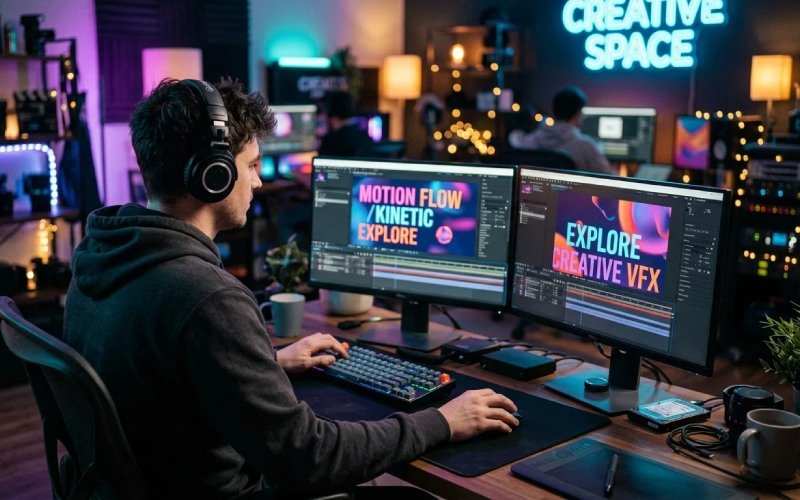
In an era defined by rapid information consumption and relentless feed scrolling, static design alone can no longer carry the full weight of modern digital branding. The modern audience demands dynamism, rhythm, and clarity. Motion graphics—the seamless fusion of graphic design, typography, illustration, UI systems, and cinematic timing—has evolved from a secondary creative embellishment into a fundamental pillar of modern brand identity, digital communication, and performance marketing across every digital channel.
Why Static Design Fails in High-Velocity Feed Environments
Modern consumers scroll through hundreds of meters of digital content every single day across desktop and mobile screens. In this hyper-competitive environment, human visual attention is biologically hardwired to prioritize movement over static graphics. Motion creates an immediate optical anchor, disrupting passive browsing habits and drawing the human eye directly to key value propositions and product highlights.
Data from global advertising platforms consistently shows that motion-based creative assets generate up to 300% higher engagement rates and 40% higher click-through rates compared to static image ads. By infusing brand graphics with intentional kinetic behavior, companies create memorable visual imprints that endure long after the user has scrolled past, dramatically improving recall and brand equity.
Kinetic Typography: Making Words Impossible to Ignore
Typography is the fundamental voice of your brand; kinetic typography is that voice brought to vibrant, rhythmic life. Rather than presenting dense, overwhelming blocks of static text, animated type introduces hierarchy, emphasis, and emotional cadence through deliberate motion choreography:
- Rhythmic Pacing: Revealing words in synchronisation with vocal emphasis ensures viewers absorb critical value metrics effortlessly without cognitive fatigue.
- Weight & Scale Modulation: Dynamically scaling font weights, tracking, and sizes creates immediate visual hierarchy, spotlighting core statistics, ROI figures, and primary calls to action.
- Emotional Resonance & Brand Personality: Subtle bounce, smooth elastic easing, and purposeful directional transitions imbue typography with distinct brand personalities—from sleek corporate authority to energetic creative disruption.
Simplifying Complex SaaS, Data & Cloud Ecosystems
One of the most impactful applications of motion graphics is in the B2B technology and software-as-a-service (SaaS) sector. Complex cloud infrastructures, AI data pipelines, cybersecurity layers, and multi-sided marketplace workflows are inherently abstract. Attempting to explain these concepts through static screenshots often results in visual clutter, confusing UI layouts, and cognitive overload for prospective buyers.
Motion graphics solves this challenge through elegant abstraction. By translating UI interfaces into clean vector components, animating real-time data flows with glowing paths, and zooming dynamically between high-level overviews and granular feature deep-dives, motion designers make sophisticated technology instantly comprehensible to non-technical executive decision-makers.
Establishing Comprehensive Brand Motion Guidelines
Just as every enterprise maintains detailed brand guidelines for logos, color palettes, and typography, modern organisations must establish formal motion guidelines to ensure unified visual expression across all digital touchpoints:
“Motion is brand identity in time. How your brand moves—whether deliberate and luxurious, or snappy and energetic—communicates identity just as powerfully as your logo itself.”
A comprehensive motion design system defines core parameters across the brand’s creative ecosystem:
- Custom Easing Curves: Standardising cubic-bezier curves for smooth, natural acceleration and deceleration across all animated UI components, loaders, and video assets.
- Transition Architecture: Defining how scenes enter, transform, and exit to maintain narrative continuity without jarring cuts or visual distractions.
- Object Hierarchy & Staging: Establishing clear visual relationships between primary content containers, secondary badges, and tertiary background visual accents.
- Iconography Micro-Interactions: Scripting micro-animations for icons and illustrations to create moments of delight across web applications, presentations, and product interfaces.
Scaling Paid Video Creatives Across Ad Networks
In modern performance marketing, creative fatigue is a constant hurdle that degrades conversion rates over time. Motion graphics provides an exceptionally agile framework for high-velocity creative testing and iterative campaign optimization. Because motion assets are built on modular vector, shape, and typography layers, creative teams can rapidly produce dozens of variants—testing different hooks, headlines, color combinations, and calls to action without the prohibitive costs of reshooting live-action footage.
By iterating rapidly based on real-time campaign data, performance marketing teams can maintain optimal return on ad spend (ROAS), combat ad fatigue, and systematically scale customer acquisition across YouTube, Meta, TikTok, and LinkedIn ad ecosystems.
The Technical Stack: After Effects, Cinema 4D, and Lottie Web Animation
Behind every seamless motion graphic lies a sophisticated toolchain. Industry-standard workflows center on Adobe After Effects for composite timing and character rigging, Cinema 4D for spatial dimensionality, and vector illustration in Illustrator and Figma. For web applications and mobile apps, exporting animations via Lottie / Bodymovin JSON enables lightweight, vector-sharp animations that load in milliseconds and respond dynamically to user scrolling and cursor hover interactions without burdening page speed.
This code-driven approach ensures that interactive marketing sites maintain lightning-fast Core Web Vitals scores while delivering rich, app-like visual interactivity that captivates prospective customers from their very first visit.
The Future of Kinetic Design in Spatial and Interactive Media
As spatial computing, interactive web interfaces, and augmented reality devices mature, the principles of motion design are extending into three-dimensional interactive environments. Responsive typography that shifts based on eye-tracking, volumetric interface elements that respond to spatial gestures, and dynamic micro-animations will soon become standard consumer expectations. Brands that invest in robust, scalable motion systems today will enjoy an insurmountable head start as these interactive platforms achieve mainstream ubiquity.
Measuring Motion Performance: Key Analytics to Track
To ensure motion graphics initiatives generate measurable commercial return, marketing teams should monitor several key engagement and conversion metrics across their analytics dashboards:
- Hook Rate (First 3 Seconds): Evaluating the percentage of viewers who stop scrolling and watch past the initial hook to optimize creative openings.
- Hold Rate (3 Seconds to 50% Mark): Assessing narrative retention to identify pacing friction points within the video structure.
- Post-Click Landing Page Engagement: Measuring bounce rates and session duration of traffic driven by motion creative assets.
- Micro-Conversion Velocity: Tracking how animated explainers and UI walkthroughs accelerate feature adoption and trial signups.
- Cost Per Acquisition (CPA) Reduction: Observing the downward trend in customer acquisition costs as high-retention motion ads replace static creative banners.
Key Takeaways for Forward-Thinking Brands
Motion graphics is the definitive language of contemporary digital communication. By translating static brand assets into living, breathing motion systems, companies cultivate unmistakable brand presence, communicate complex ideas with effortless clarity, and build lasting competitive advantages across every customer touchpoint.