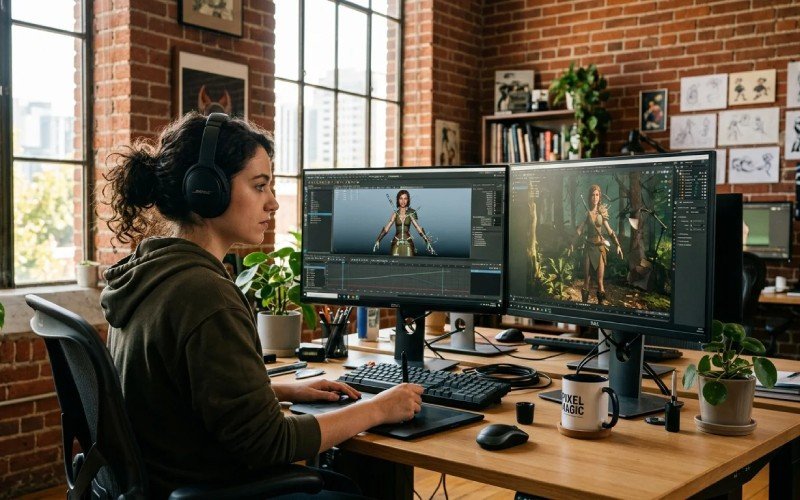
The realm of 3D computer animation, spatial visual design, and visual effects is undergoing the most profound technological transformation in over three decades. Breakthroughs in real-time GPU rendering, neural physics simulation pipelines, and procedural material synthesis have collapsed the historic boundary between high-budget Hollywood cinema and agile commercial brand storytelling. Today, forward-thinking brands across technology, luxury goods, automotive engineering, and consumer products are leveraging three-dimensional motion to present their products with unmatched fidelity, architectural precision, and cinematic grandeur.
The Real-Time Rendering Revolution in Commercial Production
Historically, high-end 3D animation was severely constrained by punishing offline render times. A single complex frame containing volumetric atmospheric lighting, subsurface light scattering, and multi-layered glass reflections could take hours to calculate on dedicated server render farms. This technical limitation created protracted review cycles, inflated production budgets, and severely restricted creative iteration during tight commercial launch windows.
The rapid maturation of real-time render engines—led by Epic Games’ Unreal Engine and GPU-accelerated ray-tracing pipelines such as Octane Render and Redshift—has fundamentally upended this dynamic. Creative directors and 3D artists can now manipulate volumetric lighting rigs, adjust physical shader roughness, and choreograph complex virtual camera paths with instantaneous, photorealistic visual feedback.
This unprecedented agility allows creative teams to explore dozens of lighting variations, lens selections, and camera movements in the time previously required for a single test render. As a result, brands receive significantly higher visual polish, richer environmental storytelling, and faster delivery timelines without sacrificing technical quality.
Hyper-Realistic Product Visualisation vs. Stylised 3D Aesthetics
Modern commercial 3D animation broadly bifurcates into two distinct strategic directions, each fulfilling specific brand positioning and marketing objectives:
1. Hyper-Realistic Product Visualisation: Predominantly deployed in consumer hardware, medical instrumentation, luxury horology, automotive engineering, and architectural developments. By importing raw CAD engineering files directly into the 3D pipeline, studios can create photorealistic exploded views, internal mechanism fly-throughs, and liquid-cooling simulation sequences long before physical tooling, injection moulding, or mass assembly has commenced. This allows marketing campaigns to launch months ahead of product shipping dates.
2. Stylised Dimensional Universes: Employed by modern software companies, fintech platforms, crypto ecosystems, and consumer lifestyle brands seeking to craft unique brand identity worlds. These animations utilise playful physics, tactile textures (such as matte silicone, frosted translucent glass, iridescent films, and brushed anodised aluminum), and vibrant, modern color palettes to humanise abstract digital workflows and cultivate distinct visual equity that competitors cannot easily duplicate.
Virtual Cinematography: Lighting, Lens Optics, and Camera Mechanics
What elevates professional 3D animation above amateur computer graphics is an uncompromising adherence to traditional cinematography principles. Inside the 3D software suite, virtual cameras are programmed with realistic optical characteristics—including subtle spherical lens distortion, chromatic aberration at the frame boundaries, shallow depth of field, and natural focal breathing during rack-focus transitions.
- Physical Three-Point Lighting Architecture: Simulating real-world key lights, diffuse fill lights, and sharp rim lights to accentuate silhouette contours, surface bevels, and material separation from the background.
- Procedural Micro-Surface Imperfections: Introducing imperceptible surface imperfections—such as microscopic dust particles, subtle roughness maps, brushed metallic grain, and subtle fingerprint smudges—which prevent models from appearing sterile, synthetic, or artificially computer-generated.
- Organic Camera Choreography: Blending mathematical bezier spline curves with subtle handheld camera shake and inertial dampening to create dynamic, cinematic immersion that feels grounded in physical reality.
Cost vs. Value: Building Reusable 3D Brand Asset Libraries
One of the most compelling economic arguments for investing in 3D animation is long-term asset reusability and modularity. When a traditional 2D animation is rendered, its assets are fundamentally flat, resolution-locked, and context-specific. In contrast, high-fidelity 3D models exist as persistent spatial assets inside a virtual studio environment.
“A well-constructed 3D master asset can yield a 60-second broadcast commercial, dozens of 4K e-commerce packshots, interactive web-based 3D configurators, and endless vertical social teasers across multiple product lifecycles.”
This modular architecture dramatically lowers the blended cost per marketing asset over time. Once a master 3D asset is modelled and textured, marketing teams can easily generate seasonal colorway updates, localized promotional variants, and interactive web experiences at a fraction of the cost of initial production, ensuring total brand consistency across global retail, digital, and broadcast channels.
The Synergy Between Generative AI and Procedural 3D Pipelines
As machine learning and AI tools integrate into professional 3D animation pipelines, their primary value lies not in replacing human creative direction, but in automating tedious, time-intensive technical bottlenecks. AI-assisted texture synthesis, automated UV unwrapping, motion-capture data cleanup, and physics-based fluid simulation enable senior animators to dedicate their full attention to storytelling, artistic nuance, and commercial messaging.
Furthermore, the emergence of Neural Radiance Fields (NeRFs) and Gaussian Splatting is opening exciting new hybrid workflows—allowing physical locations and real-world objects to be scanned into 3D environments in minutes, bridging the physical and virtual production worlds like never before.
Hardware Acceleration and Cloud Rendering Scalability
Modern production timelines demand extreme scalability. With cloud-based GPU clustering, studios can distribute heavy computational tasks across hundreds of dedicated render nodes concurrently. This means that 4K and 8K deliverables for massive trade show displays, IMAX presentations, and ultra-high-density retina displays can be completed on schedules that were unthinkable just a few years ago. Investing in cutting-edge rendering infrastructure ensures that client projects encounter zero technical ceilings regardless of deliverable resolution or frame rate requirements.
Production Milestones: What to Expect When Commissioning 3D
A professional 3D production pipeline follows structured review gates to ensure complete transparency and creative alignment at every phase of development:
- Discovery & Visual Direction: Defining material palettes, moodboards, lighting references, and core narrative goals.
- 3D Pre-Visualisation / Animatic: Building grey-box 3D geometry with camera moves to lock narrative timing, cuts, and overall pacing before detailed rendering begins.
- Detailed 3D Modelling & Texturing: Applying high-resolution physical shaders, branding marks, and surface physics to all assets.
- Lighting & Render Passes: Outputting multi-channel render passes (beauty, diffuse, specular, reflection, depth, motion vector, and ambient occlusion).
- Compositing, Colour Grading & Sound: Assembling the final image in post-production with cinematic audio, bespoke sound effects, and color mastering for broadcast and web delivery.
Strategic Takeaways for Modern Marketers
3D animation represents the pinnacle of commercial visual communication. Whether unveiling groundbreaking physical hardware, explaining complex enterprise infrastructure, or creating an unforgettable brand aesthetic, 3D motion elevates perceived product value, commands consumer trust, and positions your brand at the undisputed forefront of your industry. By treating 3D assets as scalable, long-term brand capital rather than disposable one-off campaigns, forward-thinking enterprises unlock compounding returns across their entire digital ecosystem.